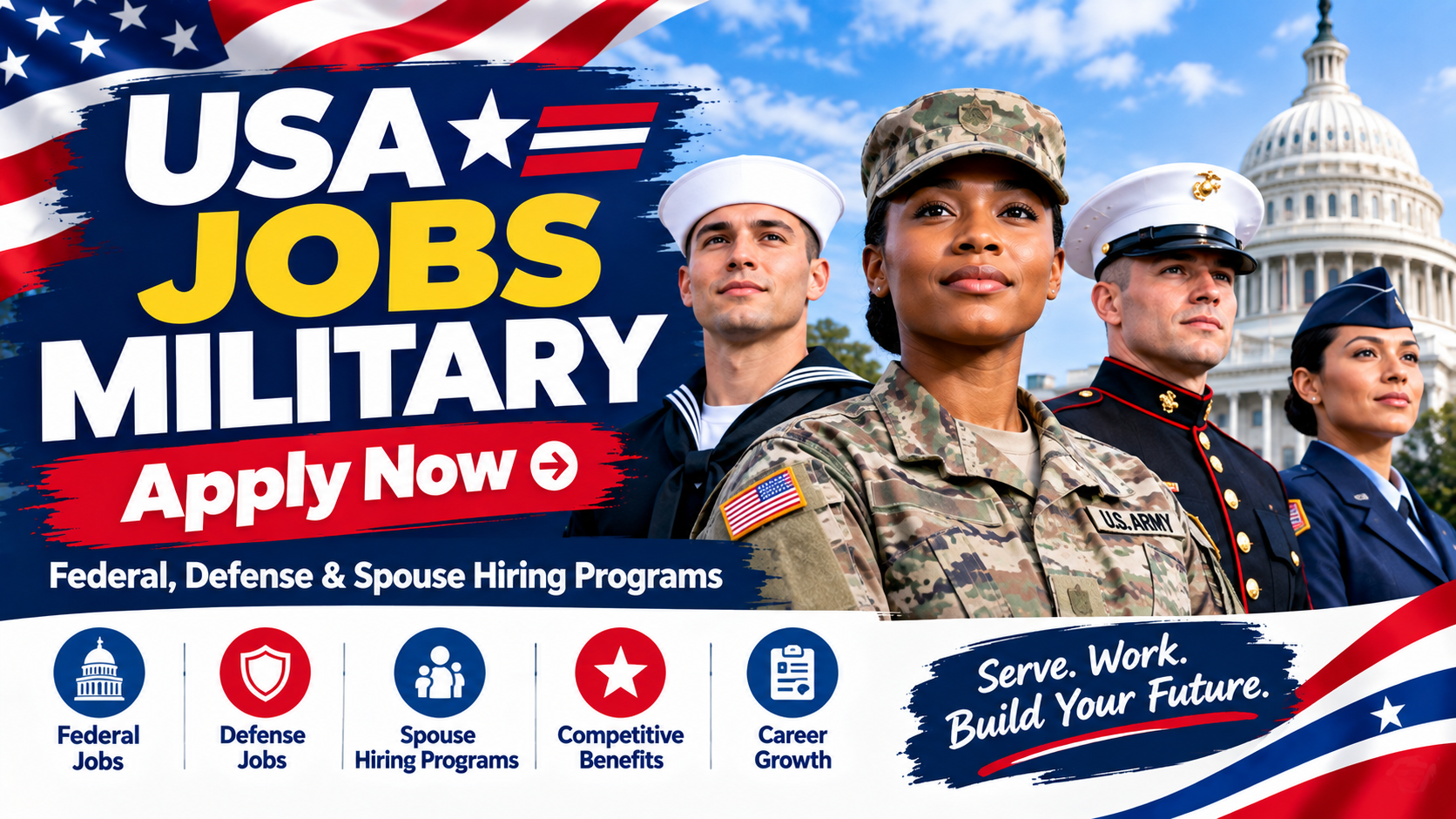
If you’re a veteran, a transitioning service member, or a military spouse looking for work in the United States, “USA Jobs Military” is one of the most searched terms for a reason. USAJOBS.gov is the official portal for every federal government job opening, and it comes with special hiring paths built specifically for the military community. But federal jobs are only part of the picture — there’s also a large, well-funded ecosystem of private-sector programs, defense contractor pipelines, and military spouse hiring partnerships that most job seekers never fully explore.
This guide breaks down what USA Jobs Military opportunities actually look like in 2026, who qualifies, and how to apply — whether you’re aiming for a federal role, a defense industry job, or something in the civilian private sector.
🌍 More Available Jobs
What Is USAJOBS?
USAJOBS is the U.S. government’s official employment site, run by the Office of Personnel Management (OPM). Every federal position — from entry-level administrative roles to senior engineering and healthcare jobs — is posted there. Unlike typical private-sector job boards, USAJOBS has its own resume format, its own vocabulary, and its own application rules, which can feel unfamiliar at first. But for veterans and military spouses, it also comes with real advantages most other applicants don’t get.
Veterans’ Preference: Your Biggest Advantage
If you served on active duty in the U.S. Armed Forces and were separated under honorable conditions, you likely qualify for veterans’ preference. This gives eligible veterans extra consideration in the federal hiring process for both permanent and temporary positions, in both the competitive and excepted service.
There are two main tiers:
- 5-point preference — for most veterans who served during eligible periods or campaigns
- 10-point preference — for disabled veterans, and in some cases their spouses or family members
Veterans’ preference doesn’t guarantee a job offer, but it does mean your application gets weighted more favorably compared to non-veteran candidates competing for the same role. One important exception: military retirees at the rank of Major/Lieutenant Commander or higher generally are not eligible for preference unless they have a qualifying service-connected disability.
Special Hiring Authorities for Veterans
Beyond preference points, several hiring authorities let federal agencies bring veterans on board without going through the standard competitive process:
- Veterans’ Recruitment Appointment (VRA): Allows agencies to non-competitively appoint eligible veterans — including recently separated veterans (within 3 years of discharge) or those who received a campaign or expeditionary medal — up to the GS-11 level or equivalent.
- 30% or More Disabled Veteran Appointment: For veterans with a service-connected disability rating of 30% or higher, this allows a temporary or term appointment without competing against the general applicant pool.
- Veterans Employment Opportunities Act (VEOA): Lets eligible veterans compete for jobs normally only open to current federal employees (“status candidates”), widening the pool of positions you can apply for.
Each authority has its own documentation requirements — usually a DD-214 (discharge papers) or a VA disability letter — so it’s worth confirming which one applies to you before you start applying.
See also:
- Work in the US: 20+ Jobs Hiring Now in 2026 | Apply Now
- United States of America Job Vacancies: 25+ Jobs Hiring Now in 2026
How to Apply for USA Jobs Military Positions
- Create a USAJOBS profile. Fill in your contact details, work history, education, and military service information.
- Build a federal-style resume. This is more detailed than a typical private-sector resume — include duties, accomplishments, and dates for every relevant position, not just a summary.
- Upload your supporting documents. This usually means your DD-214 and, if applicable, a VA disability letter.
- Search using the “Veterans” hiring path filter. On USAJOBS, you can filter openings specifically posted under veteran hiring authorities, in addition to regular “open to the public” listings where preference still applies.
- Set up job alerts. You can save searches by keyword, agency, location, and pay grade so new postings come to you automatically instead of having to check back manually.
Understanding Federal Pay: The GS Scale
Most federal civilian jobs use the General Schedule (GS) pay system. Your GS grade depends on the role and your qualifications, and your actual paycheck also includes locality pay — an adjustment based on where you’re stationed, since cities like Washington D.C. or San Francisco pay considerably more than lower cost-of-living areas. Locality pay typically adds somewhere between roughly 17% and 45% on top of base GS pay, depending on where the position is located. OPM publishes updated GS pay tables each year, so it’s worth checking the current table for exact figures before you negotiate or accept an offer.
DoD SkillBridge: Training Before You Even Leave the Military
One of the most underused paths into a strong civilian career is the Department of Defense SkillBridge program. SkillBridge lets transitioning service members — typically within their final 180 days of active duty — train with a civilian employer through internships, apprenticeships, or industry-specific programs, while still collecting full military pay and benefits.
This matters because it removes the financial risk of “trying out” a civilian career path before you separate. Major defense contractors run some of the most competitive SkillBridge pipelines:
- Lockheed Martin’s Heroes Program places transitioning service members in 3–6 month fellowships, with a reported 85% job-offer rate and an average starting salary around $105,000.
- Northrop Grumman runs a comparable program with a reported job-offer rate near 95%.
- Military spouses and caregivers are often eligible for shorter, separate SkillBridge-adjacent tracks (commonly around 6 weeks) with some of these same companies.
Because SkillBridge partnerships are employer-specific, it’s worth researching individual company programs directly rather than assuming they all work the same way — eligibility windows, application timelines, and command approval requirements vary.
Hiring Our Heroes and Other Transition Support
Hiring Our Heroes (HOH), a program under the U.S. Chamber of Commerce Foundation, connects service members, veterans, and military spouses with employers actively looking to hire from the military community. Its offerings include:
- Corporate Fellowship Programs — a 12-week, SkillBridge-approved internship model for transitioning service members
- Military Spouse Fellowship Pathways — shorter fellowship tracks designed specifically for spouses navigating frequent relocations
- Skilled Trades Academy — training pathways into high-demand fields like construction, manufacturing, and data center operations
- Hiring events and career fairs — in-person and virtual events connecting military-affiliated job seekers directly with recruiters
These programs are free to eligible participants and are worth checking even if you’re not actively transitioning yet, since many require lead time to apply.
Military Spouse Employment: A Separate but Related Path
Military spouse employment comes with its own challenges — frequent relocations (PCS moves), employment gaps, and the difficulty of building a “portable” career. Several programs exist specifically to address this:
- Military Spouse Employment Partnership (MSEP) — a DoD-led initiative connecting military spouses with hundreds of partner employers who have specifically committed to recruiting, hiring, promoting, and retaining military spouses. MSEP’s job board is accessible through MySECO.
- Company-specific spouse hiring tracks — employers such as Amazon, Microsoft, USAA, Booz Allen Hamilton, Starbucks, Hilton, and DoDEA have documented programs offering remote-friendly roles or the ability to transfer between locations rather than having to resign and reapply at every PCS move.
- Installation Employment Readiness offices — every military installation typically has a local office that can connect spouses with regional job leads and application support.
When researching “military friendly” employers, it’s worth distinguishing between companies that simply market toward military families and those with documented hiring tracks, remote-work policies, and internal transfer programs — the difference shows up in how easy your job search actually is after a move.
Private-Sector and Defense Contractor Jobs
Not every “USA jobs military” search is about the federal government specifically. A large share of veteran hiring happens through private defense and aerospace contractors, many of which run dedicated veteran recruiting pipelines:
- Large defense contractors (Lockheed Martin, Northrop Grumman, Booz Allen Hamilton, Guidehouse, and similar firms) actively recruit veterans for roles in engineering, cybersecurity, logistics, and program management — often specifically because military experience translates well into these fields.
- Many of these companies are also authorized SkillBridge partners and Military Spouse Employment Partnership members simultaneously, meaning the same employer can support both the service member and their spouse.
- Skilled trades — construction, manufacturing, and data center technician roles — are another fast-growing area for veteran hiring outside the traditional office/desk-job path.
Tips for Translating Military Experience Into a Civilian Resume
One of the biggest hurdles for veterans isn’t a lack of qualifications — it’s translating military job titles and duties into language a civilian (or federal HR system) will recognize.
- Avoid unexplained acronyms and MOS/rate codes; spell out what the role actually involved.
- Quantify results where you can — people managed, budgets handled, equipment maintained, missions supported.
- Map your military occupational specialty to its closest civilian equivalent, and use that terminology alongside your military title.
- For federal applications specifically, follow the USAJOBS resume format closely — federal HR systems are often more literal about matching keywords than private-sector recruiters are.
Frequently Asked Questions
Do I need to be recently separated to qualify for veterans’ preference? No—veterans’ preference itself doesn’t have a strict time limit tied to discharge date, though some specific hiring authorities (like VRA) do require separation within the last 3 years.
Can military spouses get preference too? Military spouses don’t receive the same preference points as veterans, but they can qualify for the Military Spouse Employment Partnership and certain non-competitive hiring authorities in specific circumstances, such as relocating due to a service member’s orders.
Is SkillBridge only for people leaving active duty? Yes, SkillBridge is specifically designed for active-duty service members within roughly their last 180 days of service, typically requiring command approval to participate.
Do I need a college degree for most USA jobs military federal positions? Not always — many federal roles accept relevant experience in place of a degree, particularly at lower GS grades, though technical and specialized roles may have specific educational requirements.
Where’s the best place to start if I’m not sure which path fits me? If you’re pursuing federal employment, start with USAJOBS.gov and FedsHireVets.gov. If you’re still on active duty and want private-sector experience first, look into DoD SkillBridge and Hiring Our Heroes. If you’re a military spouse, MSEP via MySECO is the most direct starting point.
Where to Start Looking
- USAJOBS.gov—the main portal for all federal job openings
- FedsHireVets.gov—overview of the federal hiring process for veterans
- VAforVets.va.gov—specifically for careers within the VA and support for transitioning service members
- SkillBridge.osd.mil—official DoD SkillBridge program information
- HiringOurHeroes.org — fellowships, hiring events, and spouse-specific career resources
- MySECO (MSEP job board)—military spouse employment partnership listings
If you’re serious about landing a USA jobs military position—whether federal, defense-contractor, or spouse-specific—the real advantage isn’t just knowing these programs exist. It’s making sure your documentation, resume format, and hiring-path selection line up correctly before you apply, and understanding which of these overlapping programs actually fits your situation. Taking the time to get that right can be the difference between your application getting flagged as eligible versus getting passed over entirely.